
Telehealth enterprises increasingly rely on independent 1099 clinicians to deliver psychiatric and mental health care at scale. That model works best when two things happen at the same time:
- Clinicians keep true independence in how they work
- Telehealth enterprises maintain documentation consistency that holds up for billing and audits
PMHScribe is designed for that exact reality. It supports independent clinicians who work across multiple organizations, and it gives telehealth enterprises a documentation standard that contractors actually want to use.
Telehealth enterprises run on distributed clinicians
Many psychiatrists, PMHNPs, and therapists contract with more than one organization. A single clinician may work for multiple telehealth enterprises, carry inpatient privileges, do consult coverage, and maintain outpatient panels across different settings.
The operational problem is not just charting time. It is fragmentation.
- Multiple systems and formats
- Repeated intake details
- Inconsistent note structure
- Lost continuity across organizations
- Higher burnout and administrative overhead
Telehealth enterprises feel the downstream effects when documentation becomes inconsistent across a contractor workforce. Independent contractors feel it as time loss and cognitive load.
Independent contractors need portable documentation, not another locked system
1099 clinicians are independent professionals. They do not operate like employees, and their work often spans multiple organizations simultaneously. In practice, that means they need tools that travel with them and reduce friction across settings.
PMHScribe gives clinicians a consistent workflow across multiple telehealth enterprises, allowing them to document in a predictable, defensible way without reinventing their process for every platform.
For clinicians who work across multiple organizations, the biggest benefits are:
- One documentation workflow across settings
- Reduced after-hours charting
- Consistent structure for psychiatric notes
- Reliable continuity when returning to the same patient weeks later
This is especially valuable for clinicians with mixed practice models, such as inpatient plus outpatient, consults plus telehealth, or multiple telehealth enterprise contracts.
Why telehealth enterprises benefit when clinicians use PMHScribe
Telehealth enterprises need documentation quality without exerting clinical control over independent contractors. At scale, variable documentation increases risk.
When charting varies widely across contractors, enterprises see:
- Denials and rework
- Audit exposure and clawbacks
- Inconsistent support for CPT codes
- Documentation gaps that create compliance volatility
PMHScribe improves the structure and completeness of documentation without dictating clinical judgment. The clinician remains responsible for diagnosis, treatment, and decision-making. PMHScribe standardizes documentation output to support enterprise-level quality and audit readiness.
For telehealth enterprises, PMHScribe supports:
- Consistent documentation across a distributed contractor workforce
- Stronger support for billed services
- Cleaner charts with fewer missing elements
- Lower administrative follow-up burden
A recruiting and retention advantage for telehealth enterprises
Telehealth enterprises compete for high-quality 1099 clinicians. Documentation burden is one of the fastest ways to lose contractors, especially in psychiatry, where notes can be detailed and time-consuming.
When a telehealth enterprise supports PMHScribe, it is not just offering a “nice-to-have.” It is offering infrastructure that reduces burnout while improving the defensibility of documentation.
That combination improves recruitment, satisfaction, and retention.
FAQ
Can independent contractors use their own documentation tools?
In general, yes. Independent contractors typically maintain autonomy over how they perform services, including the professional tools and workflows they use, as long as they comply with HIPAA and any applicable contract terms.
Does PMHScribe replace the official EHR?
No. The telehealth enterprise or facility EHR remains the official medical record, and clinicians finalize and sign their notes there.
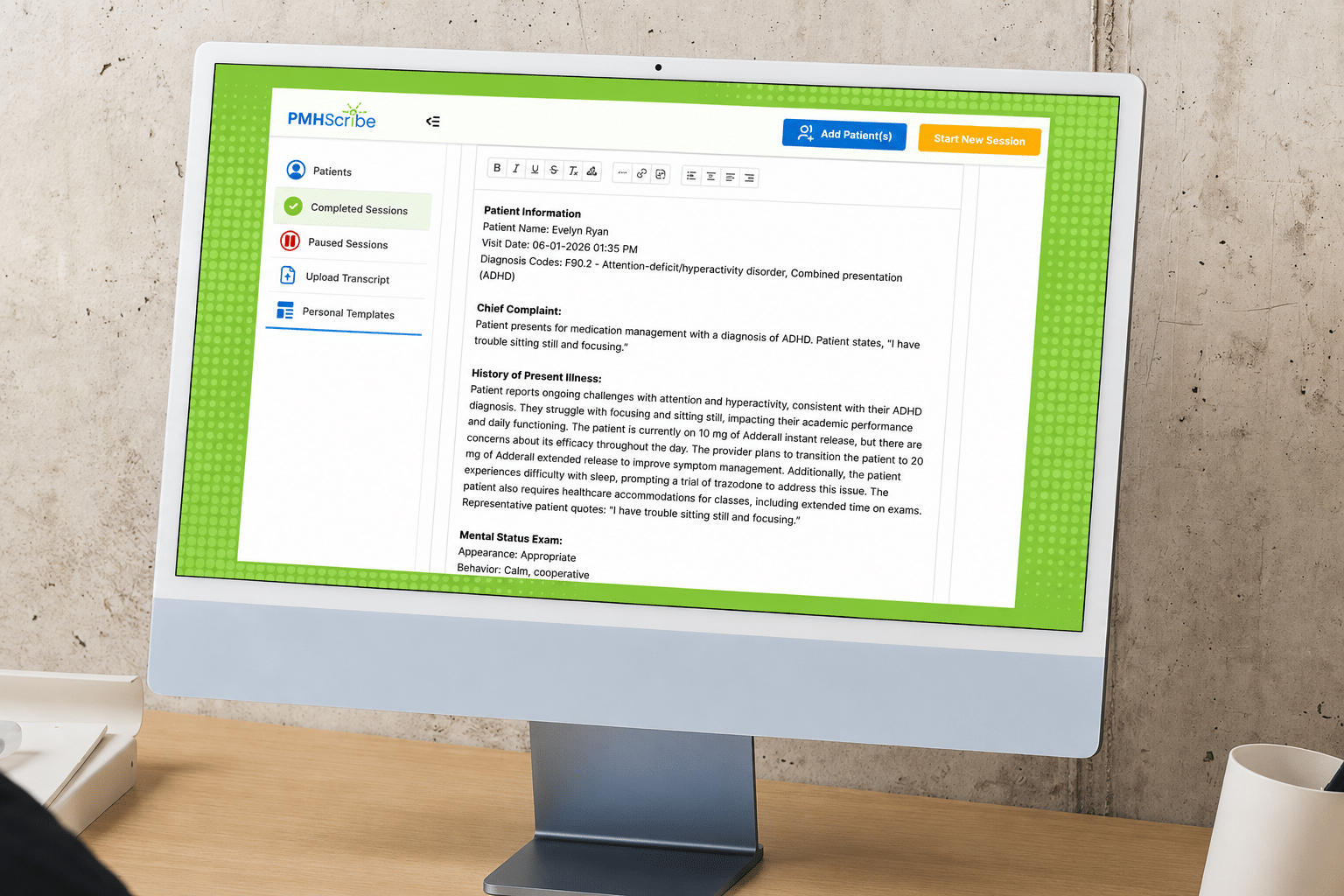
PMHScribe is a HIPAA-secure documentation system that stores transcripts and generated notes by default. A common workflow is: the encounter is transcribed, converted into a structured psychiatric note, reviewed and edited by the clinician, then copied into the telehealth enterprise’s EHR for signature.
How does PMHScribe help telehealth enterprises without controlling clinicians?
PMHScribe improves documentation structure and completeness without dictating diagnosis, treatment decisions, or clinical judgment. The clinician remains fully responsible for care, which preserves independence while strengthening documentation quality at the enterprise level.
Why is PMHScribe a strong fit for telehealth enterprises?
Telehealth enterprises operate with distributed 1099 clinicians who often work across multiple organizations. PMHScribe supports a portable documentation workflow for clinicians while improving documentation consistency and audit defensibility for the telehealth enterprise.
Resources
IRS independent contractor vs employee overview
https://www.irs.gov/businesses/small-businesses-self-employed/independent-contractor-self-employed-or-employee
IRS Topic No. 762
https://www.irs.gov/taxtopics/tc762
ABC test overview by state
https://www.wrapbook.com/blog/worker-classification-tests-by-state
IRS Form SS-8
https://www.irs.gov/pub/irs-pdf/fss8.pdf
Related reading: PMHScribe on 1099 to PaaS
https://pmhscribe.com/1099-to-paas/
CMS documentation requirements (medical record should support billed services)
https://www.cms.gov/medicare-coverage-database/view/article.aspx?DocID=L33252&LCDId=33252&articleId=57520