
Burnout in psychiatry has reached levels that are no longer sustainable. Long clinical days, emotionally intense encounters, administrative overload, and limited recovery time between patients have pushed many psychiatrists to reconsider traditional in-person workflows. While individual wellness strategies can help, the strongest evidence suggests that burnout improves most when the structure of work changes. Telepsychiatry has emerged as one of the most consistently supported ways to reduce psychiatrist burnout, backed by large-scale quantitative data and longitudinal findings. [1–3]
What the Data Show About Telehealth and Psychiatrist Burnout
The most robust quantitative evidence comes from the Veterans Health Administration (VHA). In a survey-based analysis across 2020 to 2022 of more than 44,000 physicians, including 5,577 psychiatrists, burnout rates varied meaningfully by telehealth work arrangement. Psychiatrists who were not approved for telehealth work reported the highest burnout rates, while those with full-time telehealth work reported lower burnout. After adjustment for confounders, psychiatrists reported that telehealth workers had materially higher odds of burnout, supporting a strong association between remote work access and lower burnout burden. [1]
These findings align with broader occupational burnout research showing that workplace conditions and job design, including autonomy and workload structure, are central determinants of mental health outcomes in professionals. [18]
Burnout Can Improve Over Time With Continued Telepsychiatry
Telepsychiatry appears to become more workable and less stressful as clinicians gain experience. Longitudinal data from an academic psychiatry setting using the Stanford Professional Fulfillment Index found that satisfaction with videoconferencing increased over time, while burnout decreased over the study period. Importantly, videoconferencing was not perceived to contribute to fatigue, and the authors concluded that virtual modalities may be protective against burnout within the mental health workforce. [2]
Systemwide clinician surveys also support the durability of telepsychiatry as a preferred practice model. In multisite survey data collected during the COVID-19 era, most mental health clinicians wanted telepsychiatry to remain a continuing component of care delivery. [3] Clinician experience studies similarly describe that, after rapid transitions, many teams stabilized workflows and found remote practice feasible for substantial portions of outpatient mental health care. [5]
Hybrid vs Full Telehealth and Why “Some Remote Work” Often Has Smaller Effects
Hybrid models can provide relief, but comparative evidence suggests that in-person requirements remain associated with higher burnout. At the same time, increased remote work is associated with lower levels of emotional exhaustion and occupational burnout. Cross-sectional cohort analyses examining pandemic-related teleworking patterns found associations between teleworking changes and burnout-related outcomes, reinforcing that work modality and job structure are not neutral variables. [4]
Because institutional policies can strongly influence whether remote care is workable or stressful, the benefit of telepsychiatry is often maximized when organizations implement it as a stable clinical workflow rather than a temporary exception. [5,22,23]
Why Telepsychiatry Reduces Burnout in Real Clinical Terms
The mechanisms most frequently reported by clinicians are practical and workflow-driven. Telepsychiatry can reduce or eliminate commuting, increase schedule predictability, and reduce environmental stressors that accumulate across a day of emotionally intensive work. Clinician experience studies describe improved control over the work setting and fewer logistical disruptions once systems are implemented effectively. [5]
Separately, evidence from the digital mental health intervention literature suggests that structured, technology-mediated supports can produce small but statistically significant improvements in stress and related outcomes in working populations, reinforcing the idea that well-designed digital workflows can support mental well-being rather than degrade it. [7,8] Telecoaching delivered via videoconferencing has also demonstrated measurable improvements in well-being and reductions in burnout symptoms in subsets of participants, supporting the broader concept that virtual delivery can be clinically meaningful for occupational mental health outcomes. [9]
Common Telepsychiatry Concerns and What the Evidence Suggests
Telehealth is not without drawbacks. Qualitative work describes boundary challenges for clinicians, including the risk of work encroaching on home life, as well as technology issues and workflow friction. [10] Clinician experience surveys also highlight challenges such as reduced informal peer contact, training needs, and occasional platform disruptions. [5,14,17]
However, the literature consistently indicates these issues are manageable with organizational supports, including training, reliable technology infrastructure, and intentional strategies to maintain collegial connections. [5,22,24]
Patient Care Quality Does Not Appear to Decline With Telepsychiatry
A persistent concern is whether telepsychiatry compromises clinical care. Professional guidance and outcome studies generally support telepsychiatry as clinically effective when appropriately matched to patient needs. The American Psychiatric Association’s resource documents and best-practice guidance describe telepsychiatry as effective for many outpatient psychiatric conditions and emphasize appropriate patient selection, privacy, and workflow design. [11,20]
Telepsychiatry has demonstrated effectiveness in mood disorders, anxiety disorders, substance use disorders, and collaborative care applications. [11–13] In clinician perception studies, most clinicians report that telehealth allows rapport-building and adequate clinical assessment for many outpatient scenarios. [14]
Large-scale claims-based research in Medicare populations with serious mental illness has also examined telemedicine use and quality measures such as medication adherence and continuity of mental health visits, supporting that higher telemedicine use can coincide with maintained care quality and engagement. [15] Patient and provider satisfaction studies similarly report generally favorable experiences when technical reliability and training are adequate, while identifying predictable determinants of dissatisfaction such as platform issues and insufficient support. [16,17]
Telepsychiatry is not universally appropriate for every patient, particularly those with severe symptoms, unsafe environments, or limited technology access. Professional guidance emphasizes individualized clinical judgment and ongoing monitoring to address these limitations. [11,14,20]
Telepsychiatry as a Sustainable Model for the Psychiatry Workforce
The broader physician well-being literature has increasingly emphasized that burnout is a system-level occupational syndrome requiring structural interventions. National guidance and major reviews highlight the importance of improving workflow, reducing administrative burden, measuring well-being, and creating environments where clinicians can practice sustainably. [22,23,26]
Evidence-based recommendations for sustaining the health care workforce during high-stress conditions include attention to flexible schedules, workload balancing, and rotating between higher- and lower-stress environments. While these recommendations are often framed for disaster or surge conditions, the principles apply directly to outpatient psychiatry, where cumulative load and pace drive distress. [19]
Where PMHScribe Fits Into Burnout Reduction
One of the most overlooked contributors to burnout is what happens between patient sessions. The day is not defined solely by clinical encounters but also by documentation, transitions, interruptions, and the clinician’s ability to reset. When psychiatrists work from home, short gaps between patients can be used for brief recovery activities, such as stepping away from the screen, hydrating, stretching, taking a few minutes outside, or simply taking a quiet pause before the next emotionally demanding visit. Clinician experience studies of remote telemental health describe that work-from-home conditions can reduce environmental stressors and support more workable transitions when the system is implemented well. [5]
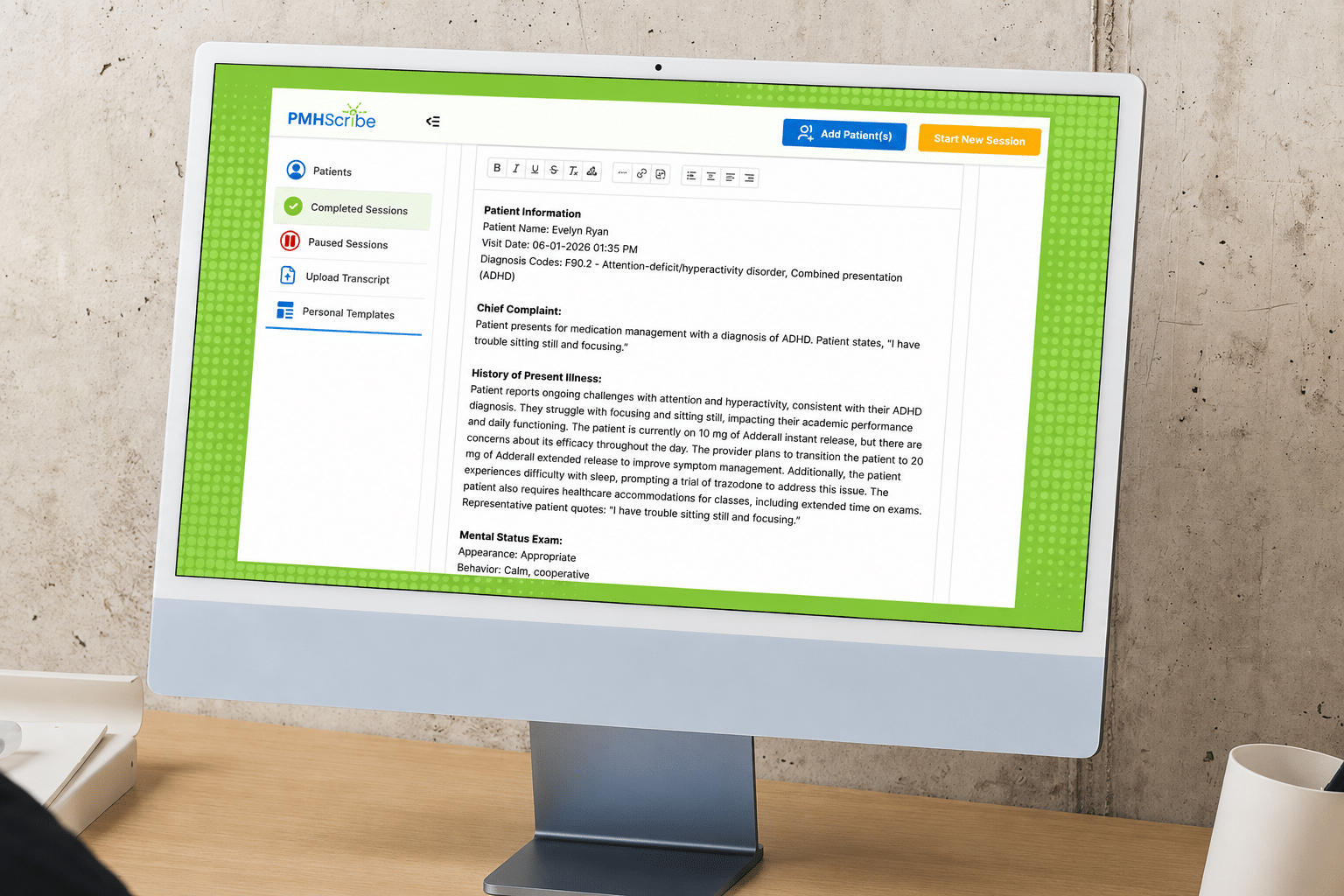
Documentation is another central lever. The well-being literature repeatedly identifies documentation burden and inefficient electronic workflows as major drivers of burnout, and major guidance emphasizes the need to reduce administrative load and optimize technology for clinicians. [22,23] PMHScribe is designed to reduce documentation burden so psychiatrists can finish accurate notes more efficiently while the encounter is fresh, rather than carrying unfinished work late into the day. When telepsychiatry and documentation relief work together, clinicians can reclaim small blocks of time between sessions for recovery and practical tasks, which is often what determines whether a day feels manageable or draining over months and years. [22,23]
Conclusion
The evidence base supporting telepsychiatry as a burnout-reducing model for psychiatrists is substantial. Large-scale quantitative findings in the VHA show meaningful differences in burnout by telehealth work arrangement, with higher burnout among those unable to work in telehealth and lower burnout among full-time teleworkers. [1] Longitudinal and multisite studies support the idea that telepsychiatry satisfaction can increase over time, and that burnout may decrease with sustained use. [2,3] Clinical effectiveness and patient care quality appear to be preserved for many outpatient scenarios, with strong professional guidance outlining best practices and appropriate patient selection. [11,14,15,20]
The implication is straightforward. If the goal is to reduce psychiatrist burnout, telepsychiatry is not simply a convenience. It is one of the best-supported structural interventions available. Tools that minimize documentation friction can amplify these gains by giving psychiatrists back time and cognitive bandwidth during the workday, particularly in the space between patients where burnout often accumulates.
- Leung LB, Yoo CK, Rose DE, et al. Telework Arrangements and Physician Burnout in the Veterans Health Administration. JAMA Network Open. 2023;6(10):e2340144. doi:10.1001/jamanetworkopen.2023.40144.
- Steidtmann D, McBride S, Mishkind M, Shore J. Examining Burnout and Perspective on Videoconferencing in the Mental Health Workforce. Telemedicine Journal and E-Health. 2024;30(7):1892-1895. doi:10.1089/tmj.2024.0071.
- Guinart D, Marcy P, Hauser M, Dwyer M, Kane JM. Mental Health Care Providers’ Attitudes Toward Telepsychiatry: A Systemwide, Multisite Survey During the COVID-19 Pandemic. Psychiatric Services. 2021;72(6):704-707. doi:10.1176/appi.ps.202000441.
- Uppal A, Pullen N, Baysson H, et al. Covid-19 Pandemic-Related Changes in Teleworking, Emotional Exhaustion, and Occupational Burnout: A Cross-Sectional Analysis of a Cohort Study. BMC Public Health. 2025;25(1):282. doi:10.1186/s12889-024-21142-z.
- Steidtmann D, McBride S, Mishkind MC. Experiences of Mental Health Clinicians and Staff in Rapidly Converting to Full-Time Telemental Health and Work From Home During the COVID-19 Pandemic. Telemedicine Journal and E-Health. 2021;27(7):785-791. doi:10.1089/tmj.2020.0305.
- Yang S, Tan GKJ, Sim K, et al. Stress and Burnout Amongst Mental Health Professionals in Singapore During Covid-19 Endemicity. PLOS One. 2024;19(1):e0296798. doi:10.1371/journal.pone.0296798.
- Stratton E, Lampit A, Choi I, et al. Trends in Effectiveness of Organizational eHealth Interventions in Addressing Employee Mental Health: Systematic Review and Meta-Analysis. Journal of Medical Internet Research. 2022;24(9):e37776. doi:10.2196/37776.
- Stratton E, Morris RW, Milton A, et al. Optimizing Workplace Digital Mental Health Interventions: Systematic Review and Meta-Analysis. Journal of Medical Internet Research. 2025;27:e71253. doi:10.2196/71253.
- Sagui-Henson SJ, Prescott MR, Corcoran JB, et al. Effectiveness of Evidence-Based Telecoaching Delivered Through an Employer-Sponsored Mental Health Benefits Platform. Telemedicine Journal and E-Health. 2022;28(4):486-494. doi:10.1089/tmj.2020.0555.
- Kotera Y, Kaluzeviciute G, Lloyd C, Edwards AM, Ozaki A. Qualitative Investigation Into Therapists’ Experiences of Online Therapy: Implications for Working Clients. International Journal of Environmental Research and Public Health. 2021;18(19):10295. doi:10.3390/ijerph181910295.
- Recupero P, Fisher CE. Resource Document on Telepsychiatry and Related Technologies in Clinical Psychiatry. American Psychiatric Association. 2014.
- Gardner JS, Plaven BE, Yellowlees P, Shore JH. Remote Telepsychiatry Workforce: A Solution to Psychiatry’s Workforce Issues. Current Psychiatry Reports. 2020;22(2):8. doi:10.1007/s11920-020-1128-7.
- Chen JA, Chung WJ, Young SK, et al. COVID-19 and Telepsychiatry: Early Outpatient Experiences and Implications for the Future. General Hospital Psychiatry. 2020;66:89-95. doi:10.1016/j.genhosppsych.2020.07.002.
- Sugarman DE, Horvitz LE, Greenfield SF, Busch AB. Clinicians’ Perceptions of Rapid Scale-Up of Telehealth Services in Outpatient Mental Health Treatment. Telemedicine Journal and E-Health. 2021;27(12):1399-1408. doi:10.1089/tmj.2020.0481.
- Wilcock AD, Huskamp HA, Busch AB, et al. Use of Telemedicine and Quality of Care Among Medicare Enrollees With Serious Mental Illness. JAMA Health Forum. 2023;4(10):e233648. doi:10.1001/jamahealthforum.2023.3648.
- Morreale M, Cohen I, Van Wert M, et al. Determinants of Experience & Satisfaction in Telehealth Psychiatry During the COVID-19 Pandemic for Patients & Providers. Frontiers in Psychiatry. 2023;14:1237249. doi:10.3389/fpsyt.2023.1237249.
- Mishkin AD, Cheung S, Capote J, Fan W, Muskin PR. Survey of Clinician Experiences of Telepsychiatry and Tele-Consultation-Liaison Psychiatry. Journal of the Academy of Consultation-Liaison Psychiatry. 2022;63(4):334-344. doi:10.1016/j.jaclp.2021.10.005.
- Rugulies R, Aust B, Greiner BA, et al. Work-Related Causes of Mental Health Conditions and Interventions for Their Improvement in Workplaces. The Lancet. 2023;402(10410):1368-1381. doi:10.1016/S0140-6736(23)00869-3.
- Sprung CL, Devereaux AV, Ghazipura M, et al. Critical Care Staffing in Pandemics and Disasters: Systems Strategies to Sustain the Health Care Workforce. Chest. 2023;164(1):124-136. doi:10.1016/j.chest.2023.03.008.
- Mishkind M, Boyce O, Krupinski E, et al. Best Practices in Synchronous Videoconferencing-Based Telemental Health. American Psychiatric Association. 2022.
- McClafferty HH, Hubbard DK, Foradori D, et al. Physician Health and Wellness. Pediatrics. 2022;150(5):e2022059665. doi:10.1542/peds.2022-059665.
- Mangurian C, Fitelson E, Devlin M, et al. Envisioning the Future of Well-Being Efforts for Health Care Workers. JAMA Psychiatry. 2023;80(9):962-967. doi:10.1001/jamapsychiatry.2023.2355.
- Guille C, Sen S. Burnout, Depression, and Diminished Well-Being among Physicians. The New England Journal of Medicine. 2024;391(16):1519-1527. doi:10.1056/NEJMra2302878.
- Wasserman M, Ford JD, Steinberg AL. Virtual Support Group Initiative for Mental Health Professionals in the COVID-19 Pandemic. Psychological Trauma. 2025;17(Suppl 1):S206-S213. doi:10.1037/tra0001791.
- Deshields TL, Wells-Di Gregorio S, Flowers SR, et al. Addressing Distress Management Challenges: Recommendations From Consensus Panel. CA: A Cancer Journal for Clinicians. 2021;71(5):407-436. doi:10.3322/caac.21672.
- Brazeau CMLR, Trockel MT, Swensen SJ, Shanafelt TD. Designing and Building a Portfolio of Individual Support Resources for Physicians. Academic Medicine. 2023;98(10):1113-1119. doi:10.1097/ACM.0000000000005276.
- Saddawi-Konefka D, Moutier CY, Ehrenfeld JM. Reducing Barriers to Mental Health Care for Physicians. JAMA. 2025. doi:10.1001/jama.2025.12587.
- Larsson M, Ho DM, Kirschner M, Seifritz E, Manoliu A. Digital Resilience Interventions for Healthcare Workers: A Systematic Review. Frontiers in Psychiatry. 2025;16:1519670. doi:10.3389/fpsyt.2025.1519670.