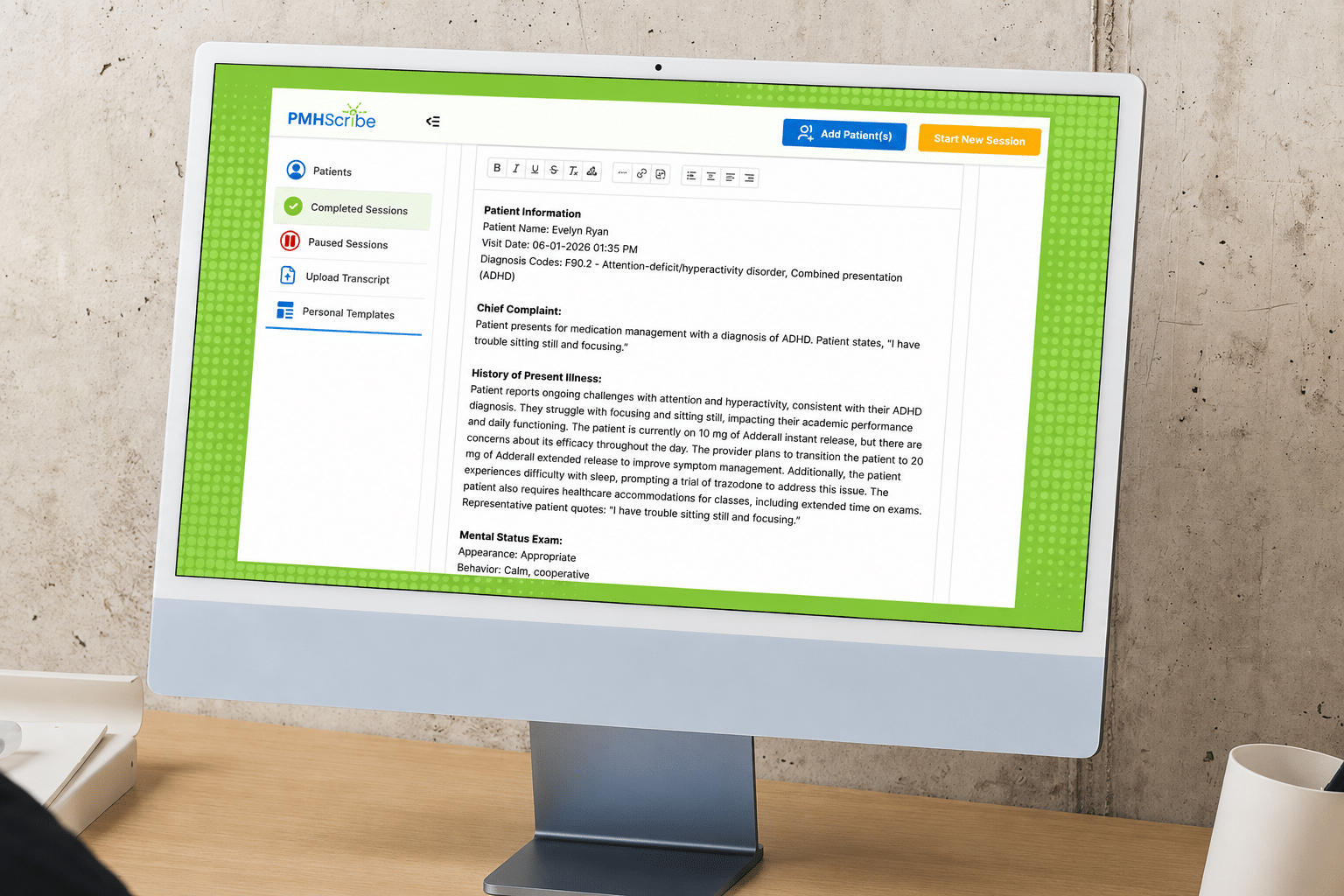

Healthcare professionals often seek peer input in online groups and professional forums. However, sharing screenshots of patient portal messages, medication decisions, or clinical documentation can expose patients to significant HIPAA violations, even when names are removed.
For psychiatrists, psychiatric nurse practitioners, physician associates, therapists, and behavioral health providers, understanding HIPAA de-identification standards is essential to avoiding HIPAA violations on social media.
What Is Protected Health Information Under HIPAA?
Under 45 CFR §160.103, Protected Health Information, or PHI, is individually identifiable health information that:
• Relates to a person’s past, present, or future physical or mental health condition
• Relates to the provision of healthcare
• Relates to payment for healthcare
The regulation further states that information is identifiable if there is a reasonable basis to believe the information can be used to identify the individual.
This means PHI does not require a patient’s name to be present. If clinical details could reasonably identify the patient, the information may still qualify as PHI.
Why Social Media Case Discussions Create HIPAA Risk
Consider a common scenario.
A provider shares a portal screenshot in a professional group. The name is removed, but the post includes:
• Medication name and dosage
• Treatment duration
• Follow-up timing
• Side effects discussed
• Date or timestamp
• Unique clinical decision-making
Even without a name, this information relates to healthcare provision. Combined details may make the patient identifiable.
Removing a name alone does not satisfy HIPAA’s de-identification standards.
The Two Legal Methods of HIPAA De-Identification
HIPAA provides two legally recognized methods of de-identification under 45 CFR §164.514:
• Safe Harbor
• Expert Determination
Both methods have specific requirements.
Safe Harbor De-Identification
The Safe Harbor method is found at 45 CFR §164.514(b)(2).
To qualify, a covered entity must remove 18 categories of identifiers, including:
• Names
• All elements of dates directly related to the individual except year
• Geographic subdivisions smaller than a state
• Contact information
• Account numbers
• Any other unique identifying number, characteristic, or code
Additionally, the entity must not have actual knowledge that the remaining information could identify the individual.
Screenshots often fail Safe Harbor because they include timestamps, portal formatting, or contextual clinical details that create identifiability risk.
Expert Determination Method
The Expert Determination method is found at 45 CFR §164.514(b)(1).
Under this method:
• A qualified expert with appropriate statistical and scientific knowledge
• Applies accepted principles
• Determines that the risk of identification is very small
• Documents the analysis and methodology
This is a formal process. It does not occur when a provider informally removes a name before posting online.
Most social media case discussions fail to meet either the Safe Harbor or the Expert Determination standards.
Understanding the “Reasonable Basis to Identify” Standard
The phrase “reasonable basis to believe” in 45 CFR §160.103 creates a risk-based standard.
In the Federal Register commentary accompanying the HIPAA Privacy Rule, HHS clarified that actual identification is not required. The question is whether identification is reasonably possible based on the information disclosed.
This is why combinations of medication details, dates, and unique treatment decisions can create HIPAA risk even without explicit identifiers.
Why Social Media Is Not a HIPAA Secure Environment
The compliance issue is not simply what is shared. It is where it is shared.
A HIPAA secure environment requires safeguards under the Security Rule, including:
Administrative safeguards:
• Workforce training
• Access management
• Risk assessments
Physical safeguards:
• Controlled device and workstation access
Technical safeguards:
• Encryption in transit
• Encryption at rest
• Unique user authentication
• Role-based access control
• Audit logging
In addition, vendors that handle PHI must sign a Business Associate Agreement.
Social media platforms generally do not provide these safeguards or BAAs for the use of PHI. Even private groups do not meet the Security Rule requirements.
How PMHScribe Minimizes HIPAA Risk
PMHScribe is a HIPAA-compliant AI scribe designed specifically for psychiatrists and behavioral health providers. Its architecture focuses on controlled handling of PHI inside a secure healthcare-grade environment.
All PHI Is Stored Inside a Secure HIPAA Environment
When PHI is captured or generated within PMHScribe, it is stored inside a HIPAA-secure cloud infrastructure that implements required safeguards.
This includes:
• Encryption in transit
• Encryption at rest
• Controlled authentication
• Role-based access controls
• Audit logging and monitoring
PHI remains inside a protected system rather than consumer messaging or social platforms.
Fully Linked PHI Is Stored in Enterprise-Grade Cloud Infrastructure
When transcript content is associated with patient identifiers, the complete PHI record is stored in enterprise-grade cloud infrastructure comparable to the secure cloud environments used by most electronic health record systems across the United States.
These systems support:
• Encrypted storage
• Redundant architecture
• Access control frameworks
• Audit logging
• High availability
• Healthcare-compliant configurations
PMHScribe follows this same infrastructure model.
Separation of Workflow Reduces Exposure
Within the documentation workflow, clinical transcript content and patient identifiers are handled in a structured manner. The provider confirms patient identity within the secure system, and the clinical documentation is associated with that patient inside the protected environment.
This reduces unnecessary duplication of identifiers and limits exposure risk while maintaining complete medical records.
Practical Compliance Takeaways for Mental Health Providers
Before sharing a clinical example online, ask:
• Does this relate to the provision of healthcare to an identifiable individual
• Does it include dates, medication details, or unique clinical facts
• Would this meet Safe Harbor or Expert Determination standards
• Is the platform protected by a Business Associate Agreement
Do not post screenshots.
Rewrite as a fully hypothetical scenario and avoid including real patient details.
HIPAA compliance is not about good intentions. It is about maintaining PHI inside environments designed to protect it.
References
45 CFR §160.103
Definition of Protected Health Information
https://www.ecfr.gov/current/title-45/subtitle-A/subchapter-C/part-160
45 CFR §164.514(b)(1)
Expert Determination Method
https://www.ecfr.gov/current/title-45/subtitle-A/subchapter-C/part-164/section-164.514
45 CFR §164.514(b)(2)
Safe Harbor Method
https://www.ecfr.gov/current/title-45/subtitle-A/subchapter-C/part-164/section-164.514
65 Fed. Reg. 82462 (Dec. 28, 2000)
Standards for Privacy of Individually Identifiable Health Information
HHS Office for Civil Rights
Guidance Regarding Methods for De-identification of Protected Health Information
https://www.hhs.gov/hipaa/for-professionals/privacy/special-topics/de-identification/index.html
HHS Summary of the HIPAA Privacy Rule
https://www.hhs.gov/hipaa/for-professionals/privacy/laws-regulations/index.html