Artificial intelligence is rapidly changing healthcare documentation, but not every AI scribe is built for behavioral health. If you’re looking for the best AI scribe for psychiatry, the most important consideration isn’t simply whether it can generate a clinical note, it’s whether it understands the unique workflows of psychiatric care.
Psychiatric documentation is fundamentally different from documentation in many other medical specialties. Medication management, psychotherapy, Mental Status Exams (MSEs), risk assessments, and longitudinal treatment planning all require thoughtful documentation that captures clinical reasoning, not just conversation.
For psychiatrists, Psychiatric Mental Health Nurse Practitioners (PMHNPs), therapists, and behavioral health organizations, choosing an AI documentation platform built specifically for psychiatry can significantly reduce documentation time while supporting consistent, high-quality clinical notes.
This guide answers the most common questions clinicians ask about psychiatric AI scribes and explains what to look for when comparing documentation platforms.
An AI scribe for psychiatry is software that helps convert patient encounters into organized clinical documentation. Unlike traditional dictation software, AI scribes help organize conversations into structured psychiatric notes that support evaluations, medication management, psychotherapy documentation, treatment planning, and follow-up visits. The best solutions reduce repetitive documentation while allowing clinicians to review and approve every final note.
Psychiatric visits are conversation-driven and require documentation that captures patient narratives, emotional presentation, clinical reasoning, medication decisions, psychotherapy interventions, Mental Status Exams, safety planning, and long-term treatment goals. Because these workflows differ significantly from general medicine, behavioral health providers often benefit from AI documentation platforms designed specifically for psychiatry.
Look for software that supports psychiatric evaluations, medication management, psychotherapy documentation, Mental Status Exams, behavioral health terminology, PMHNP workflows, telehealth visits, and privacy-conscious documentation. The right platform should fit naturally into your workflow rather than forcing you to change how you practice.
Yes. AI can help organize psychotherapy documentation while distinguishing it from medication management. Clinicians should always review and approve every final note.
Yes. AI can help organize Mental Status Exam findings into a consistent clinical format, reducing repetitive typing while keeping the clinician fully in control of the documentation.
Absolutely. PMHNPs balance medication management, psychotherapy, education, and longitudinal treatment planning. Behavioral health-specific AI documentation can help reduce administrative burden while supporting documentation that reflects psychiatric practice.
Compliance depends on the platform, not on AI itself. Healthcare organizations should evaluate privacy practices, data handling, security measures, and applicable agreements before implementing any AI documentation platform.
For many clinicians, yes. AI documentation can reduce after-hours charting, improve consistency, and decrease administrative burden while preserving clinician oversight and responsibility.
General-purpose AI can generate text but is not designed specifically for psychiatric documentation workflows. Behavioral health documentation requires specialty-specific structure, clinical reasoning, and clinician review.
Dictation software converts speech into text. AI scribes organize conversations into structured clinical documentation that is easier to review, edit, and finalize.
Feature | PMHScribe | General AI Chatbot | General Medical AI Scribe |
Built for psychiatry | ✓ | ✕ | Sometimes |
Medication management | ✓ | ✕ | Limited |
Psychotherapy documentation | ✓ | ✕ | Limited |
Mental Status Exams | ✓ | ✕ | Limited |
Behavioral health terminology | ✓ | ✕ | Limited |
Designed for PMHNPs | ✓ | ✕ | Limited |
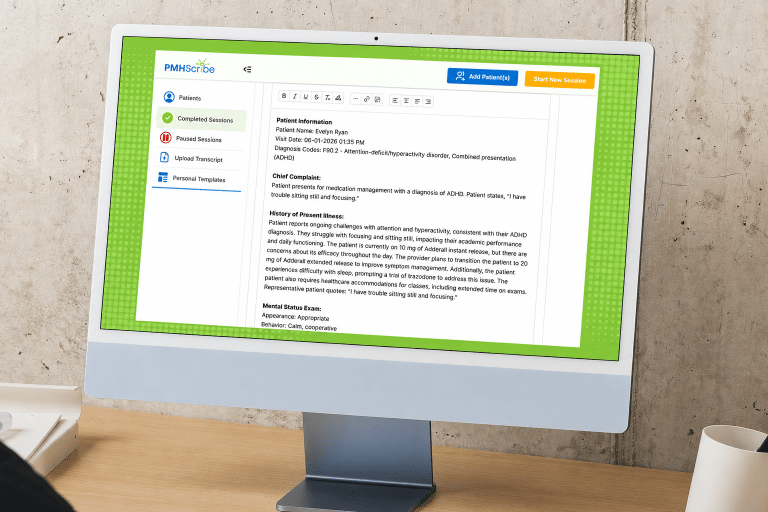
PMHScribe was built specifically for behavioral health, not adapted from a general medical AI documentation platform. Every aspect of the platform is designed around the workflows psychiatrists, PMHNPs, therapists, and behavioral health organizations use every day.
Rather than asking clinicians to fit psychiatric care into a general medical template, PMHScribe supports documentation that reflects the realities of behavioral health, including psychiatric evaluations, medication management, psychotherapy documentation, Mental Status Exams, treatment planning, and longitudinal patient care.
PMHScribe helps clinicians spend less time documenting and more time with patients while maintaining full provider oversight of every final note. Its behavioral health focus allows providers to work within documentation workflows that feel familiar instead of adapting to software built for other specialties.
PMHScribe is designed for psychiatrists, Psychiatric Mental Health Nurse Practitioners (PMHNPs), therapists, behavioral health clinics, community mental health organizations, telepsychiatry providers, and growing behavioral health practices looking to improve documentation efficiency without sacrificing quality or clinical judgment.
What is the best AI scribe for psychiatrists?
The best AI scribe supports psychiatric evaluations, medication management, psychotherapy documentation, Mental Status Exams, and behavioral health workflows while allowing clinicians to review every final note.
What is the best AI scribe for PMHNPs?
Behavioral health-specific AI documentation platforms often provide better support for PMHNP workflows than general medical AI scribes.
Can AI write therapy notes?
AI can assist with drafting documentation, but clinicians remain responsible for reviewing and approving every note.
Can AI generate Mental Status Exams?
Some behavioral health AI platforms can organize Mental Status Exam documentation based on the clinical encounter, but clinician review remains essential.
Is AI replacing psychiatrists?
No. AI documentation tools reduce administrative wor, they do not replace clinical expertise or therapeutic relationships.
Is an AI scribe worth it for small psychiatric practices?
Many independent practices use AI documentation to improve efficiency, reduce after-hours charting, and create more consistent documentation.
How do I choose the right AI scribe?
Choose software designed specifically for behavioral health that supports your documentation style, workflow, privacy requirements, and clinical oversight.
Choosing an AI scribe for psychiatry isn’t simply about finding software that can generate documentation. It’s about selecting a platform that understands the complexity of behavioral health care.
Psychiatrists, PMHNPs, therapists, and behavioral health organizations need documentation tools that support medication management, psychotherapy, Mental Status Exams, treatment planning, and the nuanced clinical reasoning that defines psychiatric practice.
PMHScribe was built with those needs at its core. By focusing exclusively on behavioral health, it helps clinicians reduce documentation time, improve consistency, and spend more of their day where it matters most, with their patients.