
Artificial intelligence is rapidly becoming part of mental health care. It can organize clinical information, summarize encounters, and generate language that appears efficient, neutral, and clinically useful.
But in psychiatry and mental health care, language is not passive. The words used to describe symptoms, diagnoses, and treatment options can shape how patients understand themselves and how clinicians conceptualize care.
As AI becomes more common in clinical settings, the central question is not only whether it works. The question is whether it remains transparent, clinically aligned, and accountable over time.
Ethical Use and Patient Data
Ethical use of AI in healthcare begins with transparency.
Clinicians and patients need clear answers to fundamental questions:
- Where is patient data going?
- Is it stored, and for how long?
- Is it used for model training?
- Is it shared with third parties?
- Can it be linked back to the patient?
These are not technical details. They directly affect patient trust, clinician responsibility, and ethical care.
Mental health data is uniquely sensitive. It often includes trauma histories, substance use, suicidal ideation, family dynamics, and deeply personal narratives.
General assurances such as “secure” or “HIPAA-compliant” do not fully address how data is handled. Ethical systems must clearly define the entire data lifecycle, including collection, processing, storage, reuse, sharing, and deletion.
Risk of Algorithmic Influence
A core risk in mental health AI is not a single incorrect output. The more serious issue is gradual influence that develops over time while the system continues to appear reliable.
This is often described as model drift or model decay.
In clinical settings, drift can occur when:
- Patient populations change
- Diagnostic patterns evolve
- Standards of care shift
- New medications enter the market
- Clinician documentation habits change
- Real-world data is used to refine systems without sufficient oversight
Over time, the relationship between inputs and outputs changes. The system may still produce clear, structured language, but its clinical alignment can weaken.
This type of degradation is difficult to detect because the system continues to appear functional.
Commercial Contamination and Data Influence
A second layer of risk involves the data that informs these systems.
If training or reference data includes:
- Industry-funded studies without clear context
- Prescribing patterns influenced by marketing
- Selective publication of positive outcomes
- Patient populations shaped by access, insurance, or pharmaceutical exposure
The system may begin to reflect those underlying patterns.
The outputs may still appear neutral, but over time, they can introduce directional trends in how diagnoses, medications, or treatment pathways are represented.
This is not necessarily intentional. It is a function of the data environment the system learns from.
The “For You Page” Effect in Healthcare
When clinical drift and data influence combine, a third effect can emerge.
Instead of simply supporting clinical decision-making, the system may begin to:
- Reinforce specific diagnostic patterns
- Surface certain medications more frequently
- Shape expectations around treatment
- Narrow perceived treatment options
- Create feedback loops based on prior outputs or interactions
This resembles a “For You Page” dynamic, where content is curated and reinforced based on underlying patterns.
In healthcare, this is not true personalization. It is an algorithmic influence within a clinical context.
How AI Language Shapes Patient Identity and Care
In mental health, language plays a direct role in care.
AI-generated language can influence how patients understand themselves, their diagnoses, and their treatment options.
If symptoms are consistently framed through a specific diagnostic lens, patients may begin to internalize that framing. A working diagnosis can begin to feel like a fixed identity.
If medication pathways are repeatedly presented as standard or primary, patients may begin to view medication as inevitable rather than one component of care.
If psychotherapy, behavioral interventions, lifestyle factors, or non-pharmacologic options are underrepresented, they become less visible in clinical discussions.
This influence does not require incorrect information. It develops through repetition, emphasis, and omission.
Repeated diagnostic framing can solidify identity.
Repeated medication framing can shape expectations.
Repeated omission of alternatives can narrow care.
Over time, these patterns can shift the trajectory of care.
The Hidden Cost of “Free”
Many AI tools in healthcare are offered at little or no cost. This lowers barriers to adoption and makes them appealing in busy clinical environments.
However, in mental health care, “free” raises an important question about how these systems are sustained.
If patient data is entered into a no-cost platform, clinicians need clarity on whether that data is stored, analyzed, shared, or used to improve future versions of the system.
If the system is supported by external funding, whether from investors, data partnerships, or industry stakeholders, those influences may shape how the system evolves.
At that point, earlier risks take on a different dimension.
Diagnostic patterns may become more consistent in one direction.
Certain medications may appear more frequently or be framed as more typical.
Alternative treatments may become less visible over time.
These changes can emerge gradually from the data being absorbed and the incentives surrounding that data.
The concern is not overt manipulation. It is a subtle, cumulative influence that develops while the system continues to appear clinically appropriate.
The Real Tradeoff: Free vs. Clinically Accountable
Choosing an AI tool in mental health care is not just a decision about cost or convenience. It is a decision about control.
A no-cost platform may provide efficiency. But if the system is learning from patient data, influenced by external funding, or evolving without clear oversight, the clinician is no longer fully in control of how clinical language and treatment framing develop over time.
In that context, “free” represents a different alignment.
Privacy-first, clinically governed systems are not just offering efficiency. They are preserving boundaries.
They ensure that:
- Patient data is not repurposed beyond the clinical encounter
- Clinical language is not shaped by external incentives
- Documentation remains under the control of the provider
In mental health care, where trust and clinical judgment are central, this distinction is operational, not theoretical.
Evidence Integrity and Transparency
AI systems are increasingly used to summarize research and support clinical decision-making.
However, medical literature is not always neutral. AI-generated summaries may not clearly indicate:
- Whether studies were industry-funded
- Whether authors had financial conflicts of interest
- Whether negative findings were underrepresented
Without this context, evidence can appear more objective than it is.
In clinical environments, transparency around evidence sourcing is essential.
Maintaining Clinical Integrity in Mental Health AI
Mental health AI systems should be designed with clinical accountability in mind.
This includes:
- Ongoing monitoring for model drift
- Auditing of diagnostic and treatment patterns
- Transparency in data sources and funding influences
- Clear policies on data storage and retention
- Explicit disclosure of whether data is used for training
- Avoidance of engagement-based or commercially driven optimization
- Clinical governance rather than purely data-driven feedback loops
The goal is not simply to improve performance. The goal is to maintain alignment with the standard of care.
PMHScribe’s Approach
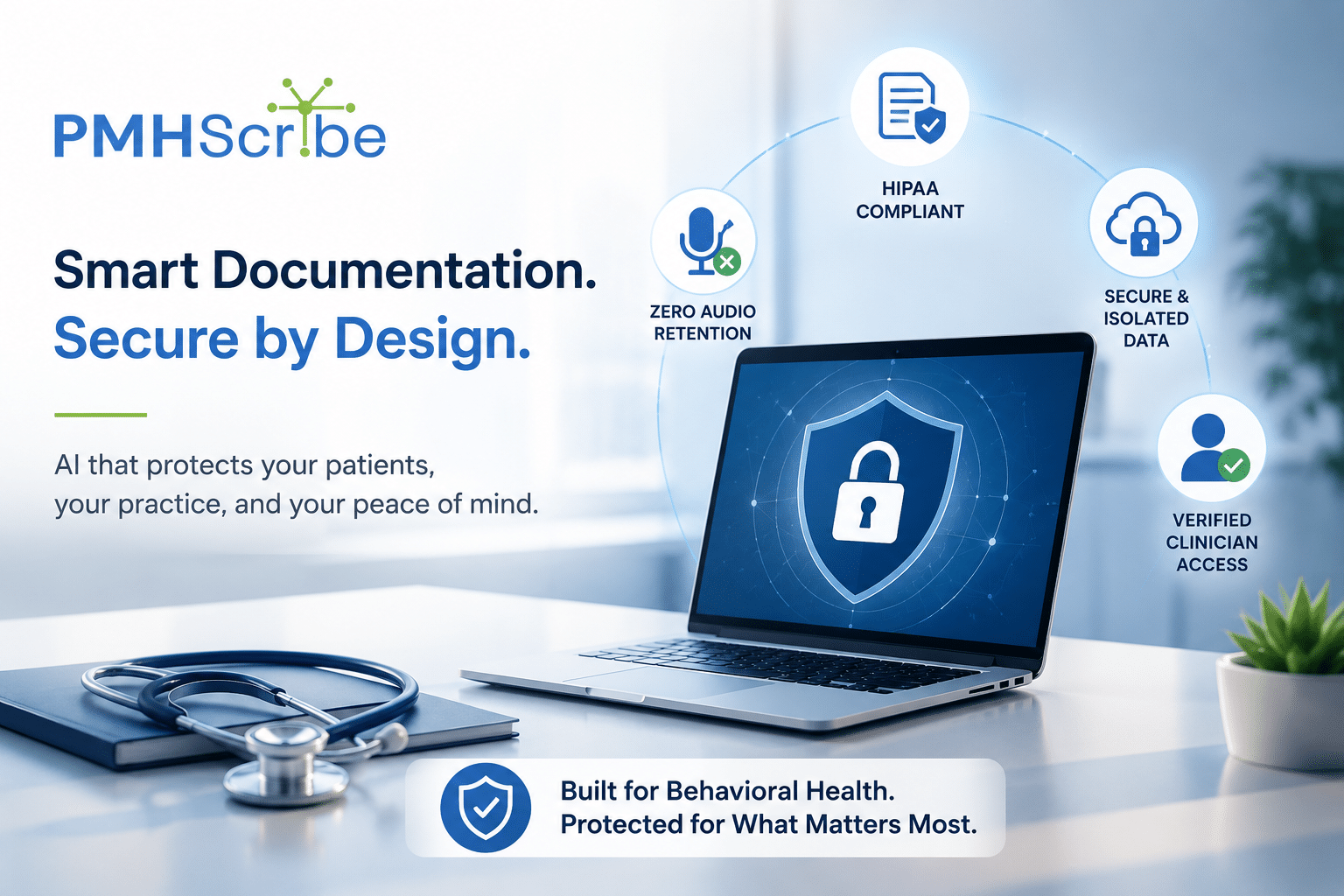
PMHScribe is designed to support mental health providers without turning patient data into a hidden training asset.
The platform follows a privacy-first model. Patient recordings are not retained after processing, and clinical documentation is generated without using patient encounters to train external systems.
This ensures that:
- Patient data remains private
- Clinical documentation reflects the provider’s judgment
- The system does not evolve based on hidden data reuse
In mental health care, confidentiality and trust are foundational. AI should support those principles, not compromise them.
PMHScribe is built to assist clinicians while preserving clinical independence, transparency, and control.
Conclusion
AI introduces a new layer into mental health care. That layer is shaped by data, language, and evolving patterns.
The central risk is not simply error. It is influence.
Over time, systems can shape how diagnoses are applied, how treatments are framed, and how patients understand themselves. When combined with opaque data practices or external incentives, that influence becomes difficult to detect.
Mental health care depends on trust, nuance, and clinical judgment.
The standard should not be that AI simply works. The standard should be that it remains transparent, private, clinically aligned, and accountable to the patient and provider.